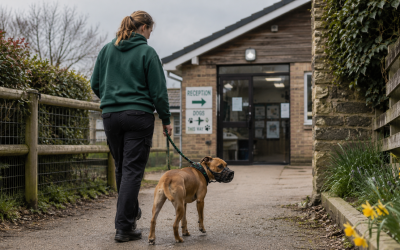
Jim Gillies CAB, CDBC is a Clinical Animal Behaviourist based in Glasgow with over a decade of experience across a wide range of canine behaviour issues. He is an APBC Full Member, ABTC Registered, and IAABC Certified Dog Behaviour Consultant — and works across clinical consultations, veterinary collaboration, and expert witness instruction. His practice is welfare-led and evidence-based throughout. Jim runs CBT Dog Behaviour & Training and shares behaviour insights through his blog and podcast.
- What Is Reactivity in Dogs?
- Reactivity vs Aggression: Why the Distinction Matters
- Why Dogs Become Reactive
- How to Help a Reactive Dog: Evidence-Based Approaches
- What to Do When Your Dog Reacts in the Moment
- Trigger Stacking and Why It Matters
- When to Seek Professional Help
- Long-Term Management and Realistic Expectations
- Frequently Asked Questions
- Further Reading

Dog reactivity is an exaggerated emotional response to specific triggers — most often other dogs, people, or movement — usually driven by fear, frustration, or over-arousal rather than aggression. It is one of the most common presentations seen in clinical behaviour practice, and while it can feel overwhelming on a daily walk, reactivity responds well to structured, welfare-led behaviour modification. This guide explains what reactivity is, what tends to drive it, and the evidence-based approaches that genuinely help. It draws on over a decade of clinical experience supporting reactive dogs and their families across Glasgow and the wider UK.
Last updated: April 2026
What Is Reactivity in Dogs?
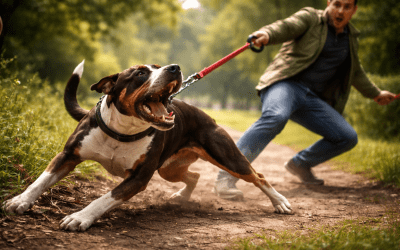
Reactivity is the term used to describe an exaggerated, often disproportionate response to a specific trigger. The trigger varies between dogs — common ones include other dogs, unfamiliar people, cyclists, joggers, traffic, livestock, or sudden environmental changes — but the pattern is consistent. The dog notices the trigger, and rather than processing it calmly, moves into a heightened state and shows behaviour that owners typically describe as “going off” or “kicking off”.
Common signs of reactivity include:
- Lunging on the lead
- Barking, growling, or whining
- Hard staring or fixed orientation toward the trigger
- Hackles raised
- Stiff body, leaning forward
- Pulling sharply when the trigger is spotted
- Difficulty taking food or responding to known cues
It is important to recognise that reactivity describes the observable behaviour, not the underlying emotional state. Two dogs lunging and barking at the end of a lead may be doing so for very different reasons — one frightened, one frustrated, one in pain, one over-aroused. Effective intervention starts with understanding which.
Reactivity vs Aggression: Why the Distinction Matters
The terms reactivity and aggression are often used interchangeably, but they describe different things.
Reactivity is an exaggerated response. It tells you something about how the dog is reacting to a stimulus.
Aggression is behaviour with a function — typically to create distance from a perceived threat, or to gain or retain access to a resource. Aggressive behaviour can include growling, snapping, biting, or air snapping.
The two overlap. Some reactive dogs do show aggressive behaviour. But many reactive dogs do not — they bark and lunge but have no intent or capacity to harm, and their behaviour settles quickly once the trigger is gone. The distinction matters because it shapes both the urgency of intervention and the approach taken.
A dog that lunges and barks at other dogs out of frustration needs a very different plan than one that does so out of fear of being attacked. Treating both with the same generic training rarely works well for either.
Why Dogs Become Reactive
Reactivity rarely has a single cause. It is usually the product of several contributing factors layered together over time.
Fear and negative associations. A dog that has had a frightening experience with another dog, a person, or a specific context may form lasting negative associations. The brain prioritises threat learning, which is why a single bad experience can shape behaviour for years.
Frustration. Particularly common in social, friendly dogs who want to greet but cannot because they are restrained on a lead. This is sometimes called lead-barrier reactivity. The frustration of not being able to get to the trigger drives the lunging and barking.
Pain or discomfort. An often overlooked factor. Dogs in chronic pain — orthopaedic, gastrointestinal, dermatological — may show lowered tolerance for environmental triggers. Veterinary involvement is essential when pain is suspected.
Limited or poorly matched early socialisation. Dogs whose early developmental window did not include broad, positive exposure to the things they will meet in adult life are more likely to find those things unsettling.
Genetic predisposition. Sensitivity, reactivity, and arousal threshold all have heritable components. Some dogs are simply wired to notice and respond more readily than others.
Learning history. Every reaction the dog rehearses strengthens the pattern. The longer reactivity has been practised, the more deeply ingrained it becomes.
In most clinical cases, more than one of these factors is at play. Identifying which apply to a specific dog is part of what a behaviour assessment is for.

How to Help a Reactive Dog: Evidence-Based Approaches
Effective behaviour modification for reactivity rests on a few well-established principles.
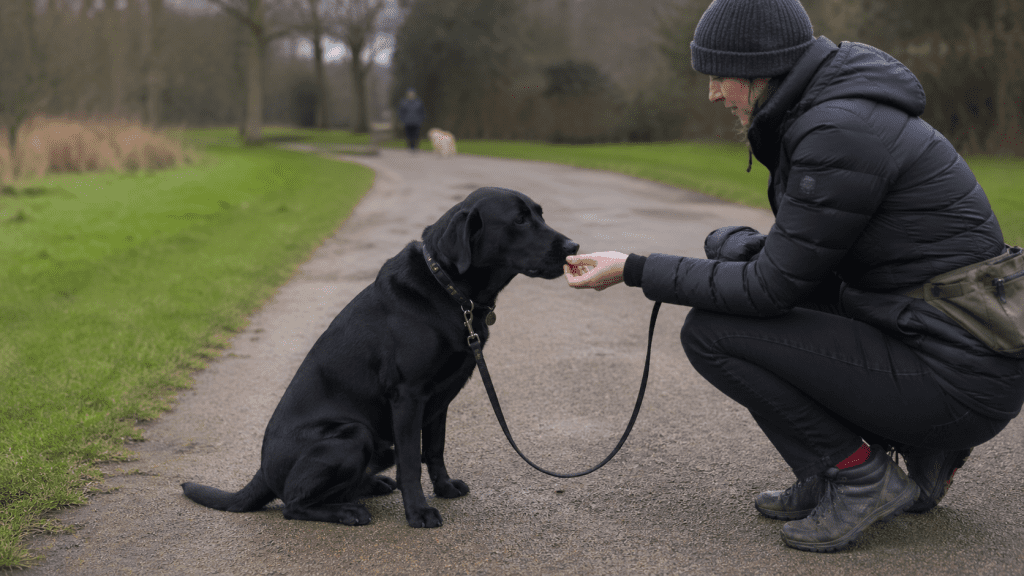
Counter-conditioning and desensitisation (CC&DS). This is the cornerstone of reactivity work. The dog is exposed to the trigger at a distance and intensity at which they can stay calm and notice without reacting, while pairing the trigger with something the dog values, usually high-value food. Over many repetitions, the dog’s emotional response to the trigger begins to shift from threatening or frustrating to neutral or even positive. Done well, CC&DS is one of the most reliable interventions in clinical behaviour practice.
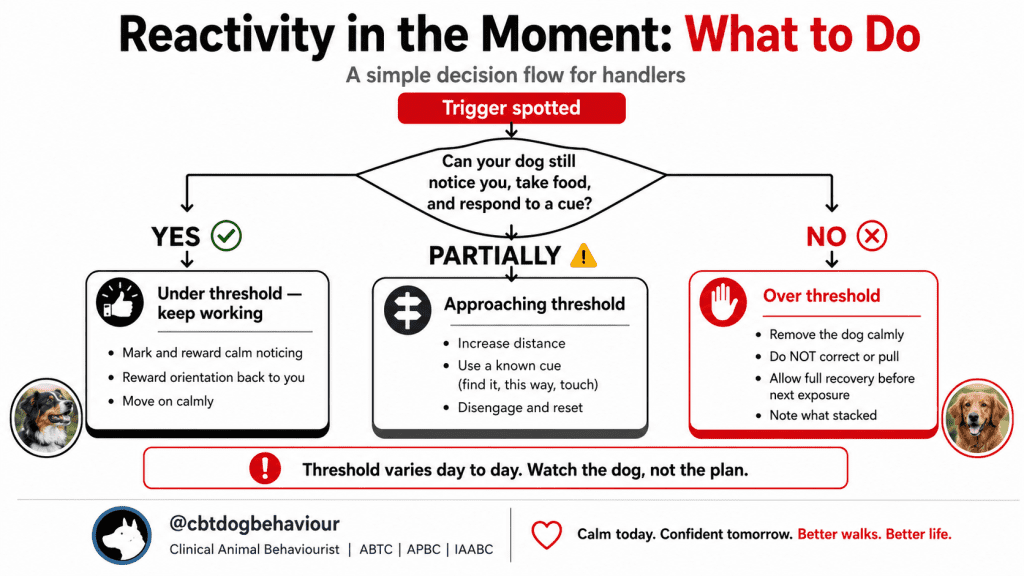
Threshold work. The single most important concept for owners to understand. Threshold is the point at which a dog moves from being able to think and learn to being unable to. CC&DS only works below threshold. If the dog is reacting, no learning is happening — the brain has shifted into survival mode. Most reactivity work therefore begins with finding distances at which the dog can notice but not react, and gradually reducing those distances over weeks and months.
Engage / disengage training. A practical method that rewards the dog for noticing the trigger calmly, then turning back to the handler. Useful because it gives both dog and owner a clear, repeatable behaviour to fall back on.
Decompression and management. Often underrated. Reactive dogs benefit considerably from periods where they are not exposed to triggers at all. Quiet sniff walks, decompression days, and reduced overall environmental load can lower baseline arousal substantially. In many cases, management changes alone produce visible improvement before any formal training begins.
In my own clinical work, the families who see the fastest progress are usually those who commit to the management side as fully as the training side. Reducing exposure while skill is built is more effective than trying to expose a dog through their reactivity. The latter is a mistake I see frequently and it almost always sets the case back.
What to Do When Your Dog Reacts in the Moment
Even with a strong plan in place, reactions happen. What you do in those moments matters.
- Remove the dog calmly. Increase distance from the trigger without dragging or scolding. The goal is to lower arousal, not to win the moment.
- Avoid corrections. Lead pops, shouting, or punishment can deepen the underlying emotional driver and worsen reactivity over time.
- Reset before continuing. A reactive episode raises stress hormones for hours. Continuing the walk as normal often leads to a second reaction. Cut the session short if you can.
- Note what happened. Distance, trigger type, time of day, what came before. Patterns emerge quickly when reactions are tracked.
The aim is not to suppress the reaction but to handle it in a way that does not make the next one more likely.
Trigger Stacking and Why It Matters
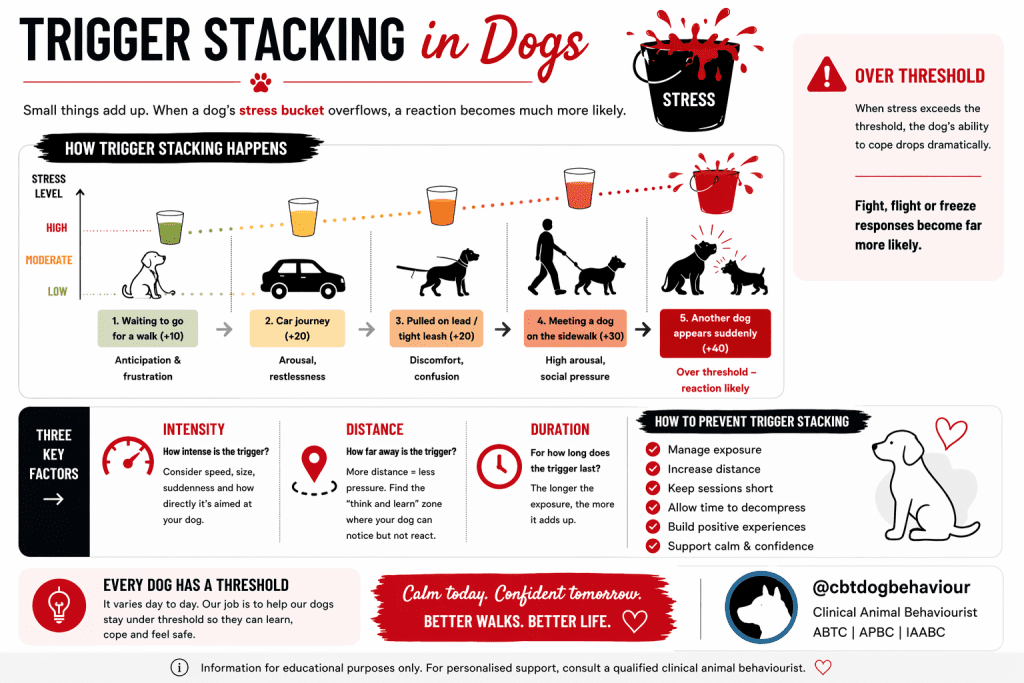
Reactivity is rarely about a single trigger. It is more often about cumulative load.
A dog that copes well with a passing car, a passing dog, and a passing cyclist on three separate walks may struggle with all three within ten minutes. Stress accumulates faster than it dissipates, and a dog whose stress bucket is already half full will react to triggers that ordinarily would not bother them.
This is why a “bad walk” can come out of nowhere. It usually has not. There is almost always a context — a poor night’s sleep, a vet visit earlier in the week, an unexpected encounter that morning — that explains why today’s threshold is lower than yesterday’s. Understanding this is one of the most useful frame-shifts for owners of reactive dogs. Read more about trigger stacking in dogs.
When to Seek Professional Help
Reactivity exists on a spectrum, and not every case needs a clinical behaviourist. Mild frustration-based lunging in an otherwise sociable dog often responds to good owner education and a structured plan. More entrenched or fear-based reactivity, particularly when accompanied by aggression, generally benefits from professional input.
Indicators that professional support may help:
- The reactivity is escalating, or the dog is biting
- The behaviour is causing distress to the dog or limiting daily life significantly
- There is uncertainty about whether pain or a medical issue is contributing
- Previous training has not worked or has made things worse
- The owner feels overwhelmed, unsafe, or out of options
The first step is usually a veterinary check, particularly if any pain or sudden behaviour change is suspected. A Clinical Animal Behaviourist will then carry out a structured assessment, identify the drivers, and build a tailored plan that takes into account the dog, the owner, and the environment.
Long-Term Management and Realistic Expectations
Reactivity is best understood as something to be managed and reduced, not cured. Many dogs make significant progress and reach a point where walks are calm, predictable, and enjoyable. Some retain a reactivity threshold that needs lifelong awareness — they are not dogs who will ever happily greet a stranger or another dog at close range, and that is fine.
Realistic goals matter. Telling an owner their dog “just needs more socialisation” is rarely accurate and often counterproductive. The aim of behaviour work is not a perfect dog. It is a dog who can move through the world with their stress within manageable limits, and an owner who knows how to support them.
The dogs who do best are those whose owners adjust expectations, commit to consistent management, and accept that progress is rarely linear.

Frequently Asked Questions
Reactivity is more accurately described as managed and reduced than cured. Many dogs make substantial progress and live calm, comfortable lives, but the underlying sensitivity often remains. The aim is to lower the intensity, frequency, and duration of reactions, and to build skills that help the dog cope with the triggers they meet.
Reactivity describes the exaggerated response. Aggression describes behaviour that has the function of creating distance or controlling access through threat. Many reactive dogs are not aggressive, though some are. A behaviour assessment can help clarify which applies to your dog.
Reactivity often becomes apparent during adolescence, between roughly six and eighteen months, when developmental changes interact with accumulating learning history. It can also emerge later, particularly after a frightening experience, a change in health, or chronic stress.
Most behaviour modification plans involve a period of reducing exposure to triggers so the dog can recover and learn below threshold. This is not avoidance for life — it is creating the conditions in which counter-conditioning can actually work. Once skills are built, structured exposure is reintroduced gradually.
Aversive methods can suppress the visible behaviour temporarily, but they do not address the underlying emotional driver and frequently worsen fear and aggression in the longer term. Reward-based, welfare-led approaches are supported by current evidence and ethical practice and are the standard in modern clinical behaviour work.
Yes, particularly if the reactivity is recent, has changed in character, or is accompanied by any other physical or behavioural changes. Pain and underlying health conditions are common but often overlooked contributors to reactivity, and behaviour work tends not to succeed if a medical driver is unaddressed.
Further Reading
- Trigger Stacking in Dogs
- Understanding Fear Aggression in Dogs
- Redirected Aggression in Dogs
- Association of Pet Behaviour Counsellors (APBC)
About Me
Jim Gillies is a Clinical Animal Behaviourist based in Glasgow, providing evidence-based behaviour support for dogs and their owners. He is an APBC Full Member, an ABTC Registered Clinical Animal Behaviourist, and an IAABC Certified Dog Behaviour Consultant (CDBC). With over a decade of professional experience, Jim works with a wide range of behaviour cases, including aggression, reactivity, separation-related distress, fears, phobias, and anxiety-related problems.
His work is grounded in ethical, welfare-led practice and focuses on practical, individualised support for each dog and household. In addition to one-to-one behaviour work, Jim shares guidance through his blog and podcast to help owners better understand their dogs and make informed decisions about behaviour support.
Contact Information
Email: jim@cbtdogbehaviour.com
Disclaimer
This post may contain affiliate links. This means I may earn a small commission at no additional cost to you if you choose to purchase through those links. Any recommendations are included where they are relevant to the topic and may be helpful to readers.
📖 Blog | 🎙️ Podcast | 🌐 cbtdogbehaviour.com