Jim Gillies CAB, CDBC is a Clinical Animal Behaviourist based in Glasgow with over a decade of experience across a wide range of canine behaviour issues. He is an APBC Full Member, ABTC Registered, and IAABC Certified Dog Behaviour Consultant — and works across clinical consultations, veterinary collaboration, and expert witness instruction. His practice is welfare-led and evidence-based throughout. Jim runs CBT Dog Behaviour & Training and shares behaviour insights through his blog and podcast.

When it comes to training dogs, the terms “impulse control” and “stimulus control” are often used interchangeably. However, recent research has shown that impulse control may not be an accurate term to describe dog behaviour. Instead, stimulus control may be a more appropriate term. In this article, we’ll explore the differences between these two terms and why stimulus control, rather than practice impulse control, may be a more effective way to train dogs.
Rethinking Dog Training: Stimulus Control vs. Impulse Control
Impulse Control vs. Stimulus Control: What’s the Difference?
Impulse control is a term that is often used in the context of animal behaviour, particularly with dogs. It refers to the ability of a dog to control its impulses in certain situations, such as resisting the urge to chase after a squirrel or to bark at a stranger. However, recent research has shown that impulse control may not be an accurate term to describe this behaviour in most dogs. Instead, stimulus control may be a more appropriate term.
If you find this article interesting, you might want to check out our blog and podcast section.
What is Stimulus Control?
Stimulus control refers to the ability of a dog to respond to certain cues in the environment, such as a command from its owner or the presence of food. This term is more appropriate because it focuses on the external stimuli that elicit the dog’s behaviour rather than the dog’s internal control over its impulses.
The Research Behind Stimulus Control
Stimulus control provides a more nuanced understanding of dog behaviour, contrasting with the simple model of dog impulse control. Key findings include:
- Dogs display greater obedience to commands in familiar environments, such as their homes, as evidenced by a University of Sydney study. This suggests environmental cues, rather than impulse control, play a significant role in their response.
- The study also noted a decrease in command-following in unfamiliar settings, indicating that dogs rely on familiar environmental stimuli, like scents or the absence of distractions, to guide their behaviour.
- Additional research showed that dogs learn tasks more effectively when they are associated with specific cues, like visual or auditory signals.
- When presented with competing stimuli, such as an unexpected noise, dogs’ ability to follow the original cue is diminished, further highlighting the importance of external cues over internal impulse control.
If you would like to learn more about these important topics, check out our course on The Fundamentals of Leaning Theory:
| Key Takeaways | Details |
|---|---|
| Difference Between Stimulus Control and Impulse Control | Stimulus control refers to a dog’s response to external cues like commands or environmental stimuli, whereas impulse control is about the dog’s emotional self control and the ability to manage internal urges. |
| Appropriateness of Stimulus Control over Impulse Control | Stimulus control provides a more accurate understanding of dog behaviour by paying attention and focusing on external factors that trigger actions, unlike dog impulse control, which is more about internal self-management. |
| Research Insights on Stimulus Control | Research shows dogs respond better to commands in familiar environments and learn tasks more effectively when linked to specific cues, highlighting the role of external stimuli over internal impulses. |
| Improving Dog Training with Stimulus Control | By focusing on external cues that elicit behaviour, trainers can modify a dog’s response more effectively, making training more efficient than a practice relying solely on managing impulses. |
| Practical Applications in Training | Trainers can incorporate stimulus control by teaching dogs to respond to specific stimuli, like a doorbell, which is more effective than trying to suppress natural impulses. |
| Recommendations for Dog Owners and Trainers | It’s recommended to adopt stimulus control in training and self control approaches, as it proves more effective in shaping dog behaviour compared to traditional impulse control training methods. |
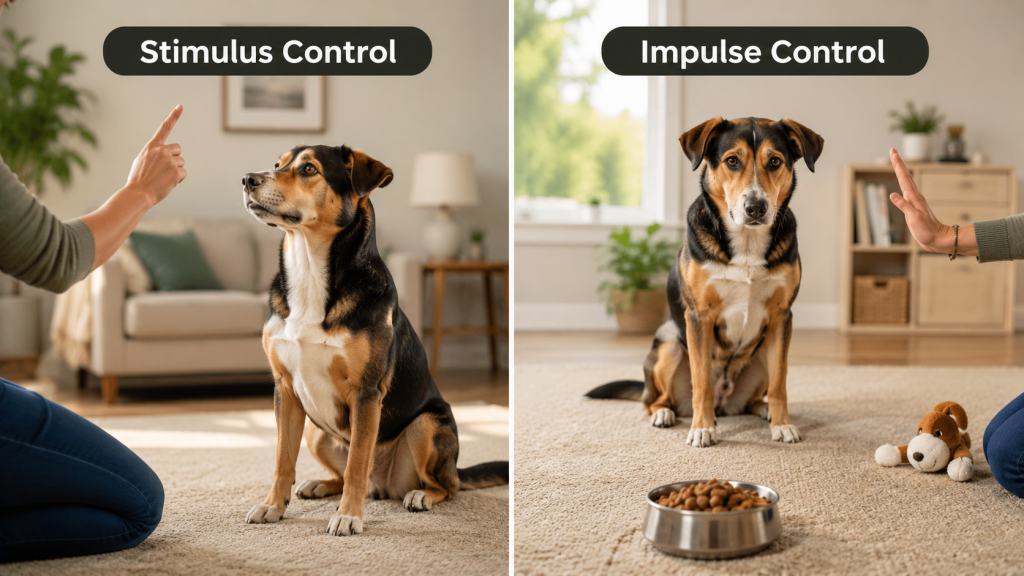
Why Stimulus Control is More Effective Than “Impulse Control” in Dog Training
When it comes to training dogs, the concept of stimulus control often proves to be more effective than the exercise of focusing solely on a dog’s impulse control. This section explores why harnessing the power of external cues in a dog’s environment can lead to more successful and efficient training sessions and outcomes.
Understanding Stimulus Control in Dog Training
- Response to Environmental Cues: Dogs are constantly reacting to their surroundings, responding to various stimuli, whether consciously or unconsciously. Recognizing and utilizing these cues is key in training.
- Training Focus: Instead of trying to suppress or control a dog’s natural impulses, stimulus control emphasizes modifying the dog’s response to specific external cues or triggers.
Practical Examples of Stimulus Control
- Barking at Strangers: Consider a common scenario where a dog barks at strangers. Traditional impulse control methods might focus on teaching the dog to inhibit the barking behaviour, similar to traditional “leave it” training. In contrast, stimulus control would involve training the dog to respond to a specific cue (like the doorbell ringing or the sight of a stranger) with a different behaviour, such as going to bed, sniffing on a playmat or licking a lick mat (the 2 latter examples of sniffing and licking being incompatible with barking behaviour!)
- Redirecting Behaviour: By focusing on external triggers, trainers can guide the dog to associate these cues with new, more desirable behaviours. This approach is often more straightforward for the dog to understand and follow.
Advantages of Stimulus Control Over Impulse Control
- Clarity and Consistency: Training that focuses on stimulus control provides clear and consistent cues, which can be easier for dogs to understand and respond to.
- Efficiency in Training: This method can lead to quicker learning, as it taps into the dog’s natural responsiveness to its environment, harnessing existing behaviours and redirecting them rather than trying to suppress natural instincts.
- Long-Term Behaviour Change: By altering the dog’s response to specific stimuli, trainers can achieve more enduring behavioural changes. This is because the dog learns to associate specific cues with specific actions.
Broader Implications for Dog Training
- Holistic Understanding of Behaviour: This approach requires trainers to have a holistic understanding of a dog’s behaviour, including the stimuli that influence it. It encourages a more empathetic and effective training method.
- Positive Reinforcement: Stimulus control often goes hand in hand with positive reinforcement techniques, further enhancing the training process and fostering a positive bond between the dog and the trainer.
Stimulus control in dog training offers a more nuanced and effective approach compared to traditional impulse control training methods. By focusing on external cues and how dogs respond to them, trainers can develop more efficient, clear, and lasting training strategies. This method not only facilitates quicker learning but also contributes to a deeper understanding and stronger relationship between dogs and their trainers.
Embracing Stimulus Control: A More Effective Approach to Dog Training
While the term impulse control has been widely used in the context of animal behaviour, particularly with dogs, recent research suggests that stimulus control may be a more appropriate term.
By focusing on the external cues that elicit certain behaviours, trainers can help dogs to learn new behaviours more quickly and effectively.
If you’re a dog owner or trainer, consider incorporating stimulus control into your training approach to teach your dog rather than viewing it as an impulse control issue.
FAQ
1. What is impulse control in dog training?
Impulse control refers to a dog’s ability to resist certain urges in different situations, such as chasing a squirrel or barking at strangers.
2. What is stimulus control in dog training?
Stimulus control focuses on a dog’s response to external cues in the environment, like commands from an owner that the dog understands, or the presence of food, rather than the dog’s internal control over its impulses.
3. Why is stimulus control considered more accurate than impulse control?
Research suggests that dogs respond more to external cues in their environment rather than controlling their internal impulses. Stimulus control focuses on modifying a dog’s response to these external cues, which can lead to more effective training outcomes.
4. What does research say about stimulus control?
Research, including studies conducted at the University of Sydney, shows that dogs are more likely to respond to familiar cues and other dogs can learn new tasks quickly when associated with specific cues. However, their response may diminish in unfamiliar environments or with competing stimuli.
5. How can stimulus control be beneficial in dog training?
By focusing on the external cues that elicit certain behaviours, trainers can work to modify the dog’s response to those cues, aiding in quicker and more effective learning of new behaviours.
6. Can you give an example of stimulus control in dog training?
For instance, if a dog barks at strangers, a trainer may teach the dog to respond to a quiet command when it hears the doorbell or sees a person approaching, focusing on modifying the dog’s response to external cues rather than controlling its impulse to bark.
7. How can I incorporate stimulus control into my dog training approach?
Consider identifying the external cues that elicit undesired behaviours in your dog and work on modifying your dog’s response to those cues through training. This approach targets the behaviour at its source to teach your dog rather than attempting to control the dog’s impulses.
About Me
Jim Gillies is a Clinical Animal Behaviourist based in Glasgow, providing evidence-based behaviour support for dogs and their owners. He is an APBC Full Member, an ABTC Registered Clinical Animal Behaviourist, and an IAABC Certified Dog Behaviour Consultant (CDBC). With over a decade of professional experience, Jim works with a wide range of behaviour cases, including aggression, reactivity, separation-related distress, fears, phobias, and anxiety-related problems.
His work is grounded in ethical, welfare-led practice and focuses on practical, individualised support for each dog and household. In addition to one-to-one behaviour work, Jim shares guidance through his blog and podcast to help owners better understand their dogs and make informed decisions about behaviour support.
Contact Information
Email: jim@cbtdogbehaviour.com
Disclaimer
This post may contain affiliate links. This means I may earn a small commission at no additional cost to you if you choose to purchase through those links. Any recommendations are included where they are relevant to the topic and may be helpful to readers.
📖 Blog | 🎙️ Podcast | 🌐 cbtdogbehaviour.com